


A Little Garden Still Counts: Rooted Living for Small Spaces
- Cori Schutlz
- 11 hours ago
- 5 min read

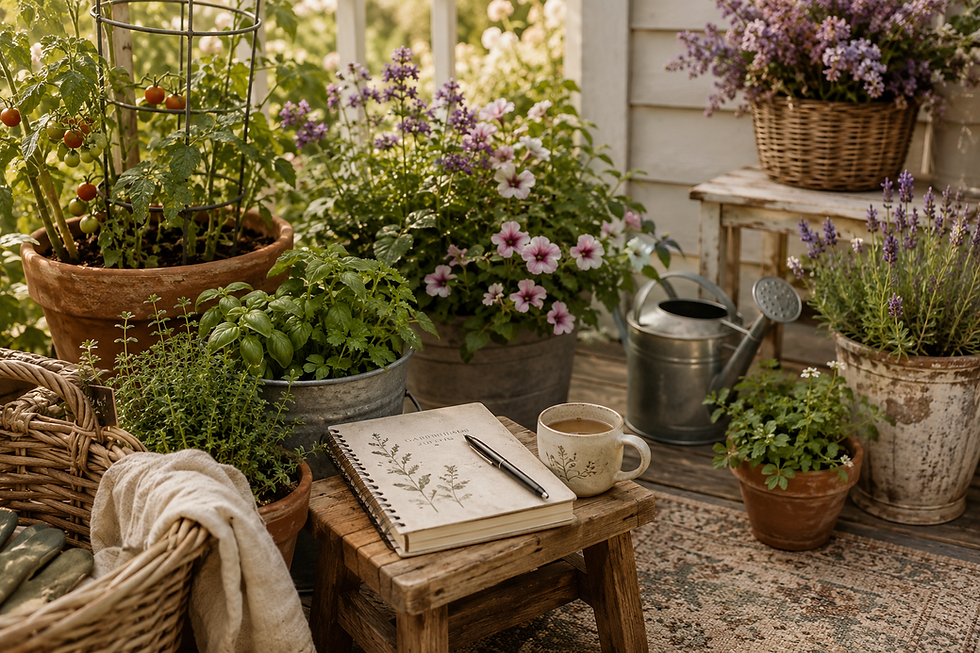
Not every garden begins with a wide backyard, a white picket fence, or rows of vegetables stretching toward the sun.
Sometimes, a garden begins with one basil plant on the kitchen windowsill.
Sometimes, it is a tomato in a five-gallon bucket, a few herbs tucked into mismatched pots, a raised bed along the side of the house, or a small patch of flowers beside the porch steps.
Sometimes, it is only a seed packet waiting patiently on the counter while life settles down enough for you to plant it.
And still, it counts.
There is a quiet kind of pressure in the world of gardening and homesteading. It can make us feel as though we need land, chickens, a pantry full of jars, a perfectly planned vegetable plot, and endless energy before we are allowed to call ourselves garden-hearted.
But rooted living is not about scale.
It is about relationship.
It is about noticing what is growing, tending what you can, creating small rituals of care, and letting the natural world find its way into your daily life—even if that life is busy, imperfect, rented, small, or still becoming.
A little garden still counts because a little garden can still teach you patience.
It can still give you mint for your tea, parsley for your soup, flowers for a jar on the table, or one warm tomato eaten outside in the evening sun.
It can still remind you that you are allowed to begin small.
You Do Not Need a Perfect Homestead to Live Seasonally

A rooted life does not require acreage.
It does not require a farmhouse kitchen, a barn, a pantry wall, or a garden that looks like the ones saved on Pinterest.
Those things can be beautiful, of course. But they are not the doorway.
The doorway is much smaller and much closer than that.
It may be the moment you step outside in the morning to check whether your container soil is dry.
It may be writing down the date your first seedling sprouted.
It may be cutting a few herbs before dinner.
It may be sweeping the porch, filling the watering can, or moving one pot into better sunlight.
Seasonal living is not something you have to perform. It is something you can practice gently, one small noticing at a time.
Your garden does not need to impress anyone in order to nourish you.
What Counts as a Small Garden?

A small garden can be many things.
It can be:
A few herbs on a windowsill.
A container garden on a patio.
A single raised bed.
A balcony with pots of flowers.
A porch step with lavender and rosemary.
A tomato plant near the back door.
A hanging basket of strawberries.
A small row of greens tucked beside the house.
A kitchen table where you start seeds in reused containers.
A rented yard where you are careful not to plant anything permanent.
A dream garden you are slowly planning for the future.
If you are tending life, learning from the season, and creating a little beauty where you are, then you are already practicing rooted living.
The size of the garden is not the measure of its meaning.
Small Gardens Are Easier to Know Deeply

There is a special tenderness to a small garden.
When you only have a few plants, you notice them more closely. You learn their moods. You see which one wilts first in the afternoon heat. You remember which pot dries out fastest. You notice the tiny new leaves, the first flower, the first pest nibble, the first fruit forming.
A small garden invites intimacy.
Instead of feeling responsible for everything, you can become familiar with a few living things and learn from them slowly.
That is a beautiful way to begin.
You do not have to know every plant, every pest, every soil amendment, or every gardening method. You can start with one plant and ask simple questions:
What does this plant need from me this week?
Is the soil dry or damp?
Is it getting enough light?
What changed since yesterday?
What do I want to remember next time?
These little questions are the beginning of garden wisdom.
A Gentle Way to Start a Small-Space Garden

If you are beginning with limited space, choose simplicity over ambition.
Start with plants you will actually use, enjoy, or feel happy tending. A useful little garden is often more satisfying than an impressive one that overwhelms you.
For a kitchen windowsill, herbs are a lovely place to begin. Basil, parsley, mint, thyme, and chives can bring freshness into everyday meals without requiring much space.
For a porch or patio, try a few containers with herbs, flowers, greens, or one compact tomato plant. Choose pots with drainage holes, place them where they receive the right amount of sun, and keep your watering routine simple.
For a balcony, think vertically. Hanging baskets, railing planters, and stacked pots can help you grow more without taking up much floor space.
For a tiny yard, one raised bed can hold more than you might expect. A small bed with herbs, lettuces, radishes, flowers, and one or two favorite vegetables can feel abundant without becoming unmanageable.
And if this is a season where you cannot grow much at all, you can still live rooted. Buy a bundle of herbs from the market. Keep flowers in a jar. Visit a local farm stand. Plan next year’s garden. Learn one new skill. Make one seasonal recipe.
There are many ways to belong to the season.
Keep Notes, Even for a Little Garden

One of the kindest things you can do for your future self is to keep simple garden notes.
They do not have to be elaborate.
You do not need perfect handwriting, color-coded systems, or daily entries.
Just write down what you will wish you remembered later.
What did you plant?
When did you plant it?
Where did you place the pot or bed?
When did it sprout?
Did it like the sun there?
Did it need more water than you expected?
Did you enjoy growing it?
Would you plant it again?
A little garden becomes more meaningful when you keep its story.
Your notes turn scattered memories into useful wisdom. They help you see that even mistakes are part of the harvest. A plant that struggled this year can teach you what to change next year. A variety you loved can become part of your seasonal rhythm. A small success can remind you that you are learning.
Garden notes are not about proving you did everything right.
They are about remembering what the season taught you.
Rooted Living Begins Where You Are

It is easy to postpone the life we want because we think we need better circumstances first.
A bigger yard.
More money.
More time.
More energy.
More knowledge.
A calmer home.
A different season.
But rooted living is not something that only begins once everything is ideal.
It begins in the middle of real life.
It begins when you choose one small thing to tend.
It begins when you make beauty useful.
It begins when you stop dismissing the small things as too small to matter.
Your little herb pot matters.
Your porch tomato matters.
Your notes matter.
Your longing for a slower, softer, more grounded life matters.
You do not have to become someone else before you begin. You can start with the space you have, the energy you have, and the season you are actually living in.
A Small Garden Ritual for This Week
Choose one plant, pot, window box, raised bed, or garden dream to tend this week.
Then take five quiet minutes with it.
Notice what is growing.
Check the soil.
Remove one dead leaf.
Turn the pot toward the light.
Harvest a few herbs.
Write down one thing you learned.
That is enough.
A rooted life is not built all at once. It is built through small returns.
Again and again, we come back to what needs tending.
Again and again, we make a little room for beauty.
Again and again, we remember that a little garden still counts.


Comments